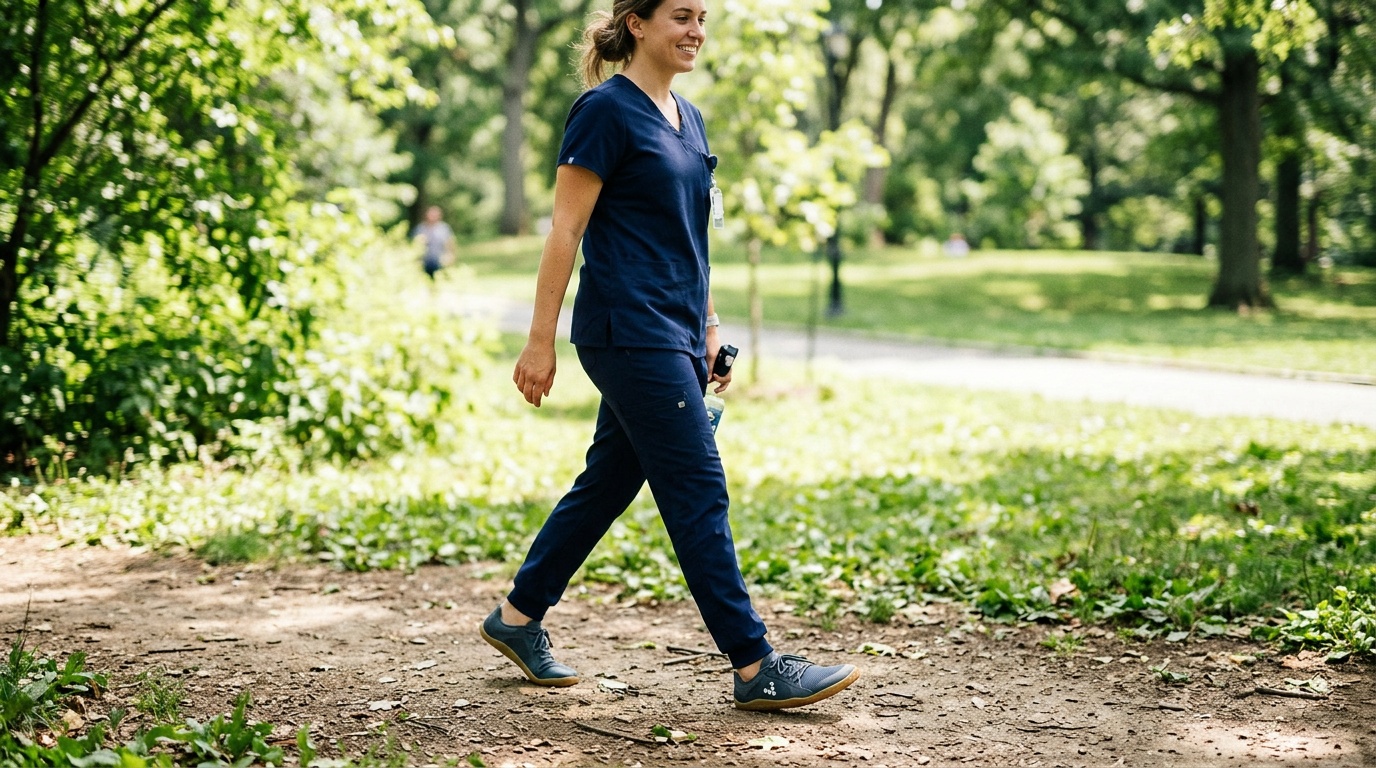
I would choose barefoot shoes for nurses by checking the outsole and cleaning requirements before worrying about how thin the sole feels. For long healthcare shifts, my priorities are dependable workplace traction, an upper you can clean according to your facility’s rules, room for your toes, and enough underfoot protection to finish comfortably. Zero-drop is useful only if your feet and lower legs tolerate it.
After six years of barefoot-only running, I am comfortable with minimal footwear. That does not make a 12-hour hospital shift a sensible beginner session. My own transition while working through IT band trouble taught me to respect changes in load; it did not prove that barefoot shoes cure injuries. Here is how I would evaluate a work pair, and how I would introduce it without making the busiest part of your week the experiment.
As an Amazon Associate, BarefootRanked earns from qualifying purchases.
1. Decide whether barefoot shoes fit your actual job
“Healthcare worker” covers very different days. A nurse moving between patient rooms, a technician standing at a bench, and a therapist demonstrating exercises do not need exactly the same shoe. Start with your facility’s written footwear requirements, including closed toes and heels, permitted materials, slip resistance, and any department-specific protective requirements. A barefoot label does not establish compliance.
My fast answer: barefoot shoes can be a reasonable option for an adapted wearer whose chosen pair meets workplace requirements. They are a poor gamble when you need protection the shoe does not provide, or when the plan is to replace supportive work shoes with an ultrathin pair overnight.
| Your workday | Prioritize | Main compromise to consider |
|---|---|---|
| Frequent walking between rooms | Secure heel, toe room, flexible forefoot, suitable traction | A flexible sole still needs enough protection for repeated steps on hard flooring |
| Long periods standing at a station | Comfortable cushioning and room as feet swell | The thinnest sole may feel worse during sustained standing |
| Wet areas or frequent spills | Documented slip performance appropriate to the floor and contaminants | Everyday barefoot sneakers may lack relevant testing |
| Areas with strict cleaning or protective-footwear rules | Approved construction and compatible cleaning instructions | A minimalist option may not meet the requirements |
You can adopt a roomier toe box without adopting every minimalist feature immediately. If your current shoes work except for squeezing your toes, start by solving that problem. You do not owe the barefoot category an all-or-nothing commitment.
2. Treat traction as a requirement, not a bonus
Deep tread, a rubber sole, and a “non-slip” marketplace headline are not enough information. Ask the manufacturer what slip testing applies to the exact model, which surfaces and contaminants were involved, and whether the documentation meets your employer’s requirements. Testing describes particular conditions; it does not guarantee grip on every hospital floor.
The Health and Safety Executive’s footwear guidance makes two useful distinctions: oil resistance is not the same as slip resistance, and test surfaces may not represent your workplace. It also notes that wear and clogged tread can change grip. That is why I would take documented performance and an employer-approved assessment over an impressive-looking tread pattern.
Check the exact outsole version
Brands sometimes sell a casual model and a work-oriented version with similar names. Do not assume the ordinary version inherits the grip claims of the work version. Match the model name, outsole, and product documentation before ordering. A trail outsole designed around loose ground is not automatically suited to smooth, damp flooring.
Once in use, inspect the outsole regularly for worn areas, embedded debris, and damage. Follow cleaning instructions so tread channels stay clear. Report slippery conditions through workplace procedures; shoes are only one part of preventing a fall. Do not deliberately test traction by sliding across a wet corridor.
3. Choose an upper you can actually maintain
Airy knit feels appealing halfway through a hot shift, but open fabric can absorb spills and be harder to wipe down than a smooth upper. For many clinical roles, I would start the search with closed, smooth leather or an appropriate synthetic material, then check the facility’s requirements against the manufacturer’s cleaning directions.
These are separate questions: can you remove visible dirt, can you use the required cleaning or disinfection process, and does the shoe provide the fluid protection your role requires? “Wipe-clean,” “water-resistant,” and “waterproof” answer different questions. None, by itself, establishes suitability for occupational exposure.
Read the care instructions before buying
Look for guidance covering the upper, seams, outsole, and removable footbed. If your facility requires a particular disinfectant, confirm compatibility rather than assuming leather can tolerate it. Harsh chemicals, soaking, and high heat may damage materials or adhesives. Household shoe-care advice is not a substitute for your department’s contamination procedures.
A removable insole can make routine drying easier when the instructions allow it. A second suitable pair may also be practical if one pair cannot dry between shifts. Breathability matters, but I would not trade a required protective feature for a cooler upper.
4. Fit the toes generously and the heel securely
A wide toe box should let your toes lie naturally instead of steering your big toe inward or pressing your little toe against the edge. It should not leave the whole foot sliding around. Nurses turn, stop, reach, and step backward; a roomy front needs a secure midfoot and heel behind it.
Try shoes near the end of the day with your normal work socks and any prescribed inserts. The AAOS shoe-fitting guidance also recommends end-of-day fitting. Check both feet, since the larger one usually determines the space you need.
- Length: Start with roughly a thumb’s width beyond your longest toe, then check the brand’s guidance and how securely the shoe holds you.
- Width: Toes should spread without hanging over the sole platform or pressing firmly into the upper.
- Depth: Toenails and the top of your forefoot should not rub, especially with your work socks.
- Heel hold: The heel should remain secure during normal turns without painfully tight laces.
- Movement: Walk, stop, and turn on a clean, dry surface while preserving the return conditions.
One coaching rule I carry over from running: do not fix the wrong shape by buying a much longer shoe. Extra length can introduce sliding without giving your big toe the space it needs. Likewise, leather softening over time will not widen an undersized sole platform.
Socks can undo a good fit if they bunch or squeeze the toes together. If ordinary socks feel restrictive, wide toe-box moisture-wicking socks are a category worth comparing. Check their thickness inside the shoe; adding bulk changes the fit.
5. Understand zero-drop, cushioning, and walking mechanics
Zero-drop means the heel and forefoot sit at the same height. It does not mean zero cushioning. Stack height describes how much material sits under your foot, while flexibility describes how readily the shoe bends. You can choose a level platform with more cushioning instead of going straight to a very thin sole.
Removing a familiar heel lift changes the position and demands experienced by your ankle and lower leg. In my coaching approach, that counts as a training change even if your step count stays the same. Your calves may notice it before the wide toe box stops feeling novel.
Do not force a forefoot walking pattern
The running advice beginners most often misapply is “stay off your heels.” Normal walking commonly includes heel contact. You do not need to tiptoe around a ward to wear barefoot shoes correctly. Let your heel settle, keep your steps comfortable, and avoid deliberately reaching farther forward or holding yourself up on your toes.
Standing is another task again. A shoe that feels lively on a short walk can feel unforgiving during prolonged stationary work. Choose cushioning based on your actual duties, and change position when work allows. There is no coaching prize for feeling every seam in the floor.
I also would not promise that barefoot shoes prevent foot, knee, or back pain. The AAOS discussion of barefoot running emphasizes individual response and injury risks associated with changing footwear and mechanics. Running evidence does not establish that minimal shoes are better for nursing shifts.
6. Shortlist work-oriented designs before casual sneakers
I would investigate these designs before buying a generic knit barefoot trainer for clinical work. These are specification-based candidates, not claims that I have tested them on a ward. Confirm current availability, cleaning compatibility, and employer acceptance before buying.
Lems Kourt Grip: a candidate when you want more underfoot material
The Lems Kourt Grip product specifications list a natural-shaped wide fit, zero drop, full-grain leather upper, full rubber grip outsole, and 13 mm stack height. Lems lists no waterproofing. That combination makes it worth investigating if toe space and a level platform appeal to you but an ultrathin sole does not.
I would still ask for the slip-test information your workplace requires and check the permitted cleaning products. The grip branding is a reason to investigate this model, not blanket approval for clinical use.
Xero Prio All-Day SR: check the specific work version
The Prio All-Day SR manufacturer listing describes a full-grain leather upper and slip-resistant rubber sole. The SR designation matters: do not substitute the regular Prio based on the shared name. Availability can vary by market, so verify the exact model and size before planning your transition around it.
If comparing marketplace listings, use the Xero Prio All-Day SR shoe search and inspect each result carefully. This is a search link because the exact Amazon product match is uncertain. Check the seller, return policy, and model description rather than assuming every result is the SR version.
If neither design meets your workplace rules or fits properly, widen the search to compliant work shoes with generous toe room. Your off-duty shoes can provide the minimalist experience while your work pair handles the job’s requirements.
7. Build shift tolerance outside the shift first
My strongest transition warning is simple: an easy first outing is not proof you are ready for a full shift. My running experience taught me to assess the following morning as well as the session itself. Delayed soreness matters when tomorrow contains another long day on your feet.
- Start off duty. Try 15–30 minutes of easy wear on a low-demand day. This is a conservative starting example, not a validated schedule for everyone.
- Repeat before extending. Look for comfortable walking during use and your usual baseline the next morning. Shorten exposure if symptoms increase.
- Build ordinary daily wear. Increase gradually over multiple outings. Avoid simultaneously increasing running mileage, calf training, and minimalist shoe time.
- Introduce work exposure only when practical. If your workplace permits changing shoes, begin with a manageable portion of a shift and keep your familiar compliant pair available.
- Judge consecutive days. Comfortable performance and recovery across repeated days matter more than surviving one shift through determination.
If changing shoes mid-shift is impractical, keep building tolerance off duty rather than using a full shift as the next automatic step. There is no universal two-week deadline. Keeping some cushioning, or keeping your existing work shoes altogether, is a reasonable outcome.
Do not label escalating pain “foot strengthening.” Stop increasing exposure if you develop persistent Achilles pain, focal foot pain, swelling, or a limp, and seek clinical assessment. If you have reduced sensation, an active foot condition, or prescribed orthotics, discuss the change with your treating clinician before removing protection or support.
Frequently asked questions
Are barefoot shoes good for 12-hour nursing shifts?
They can work for some adapted wearers, provided the shoes meet workplace requirements and stay comfortable throughout repeated shifts. The shift length alone does not tell you whether a shoe is suitable. Prior experience, standing time, fit, cushioning, and traction all matter.
Do nurses need the thinnest barefoot sole?
No. Toe room and a level platform do not require an ultrathin outsole. More underfoot material may be the better compromise for prolonged standing. Choose what supports comfortable work and recovery.
Can I keep my orthotics in barefoot shoes?
Sometimes, if the shoe has adequate depth and the insert sits securely. Orthotics change the internal fit and may change the effective heel-to-toe height. Keep prescribed support unless your clinician advises a change; removing it and changing shoes simultaneously complicates the transition.
What should I check before the first shift?
Confirm employer acceptance, exact-model traction information, cleaning compatibility, and secure fit with your work socks. Then confirm that ordinary off-duty wear feels comfortable during use and afterward. Buy for the work you do, and let repeated comfort earn the longer hours.